
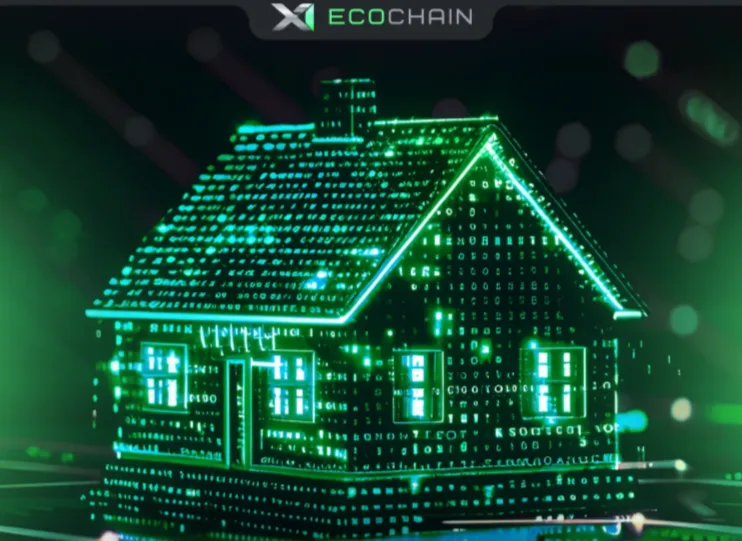
Today, most blockchains loudly proclaim their decentralization, but in practice they are still just as dependent on powerful data centers, industrial servers, and energy-insatiable infrastructure. The real picture is that there are thousands of machines tucked away in industrial hangars, managed by a limited number of operators. This is not decentralization. This is a new form of centralization, only on the blockchain stack.
It is against this illusion that X1 EcoChain — the world’s first blockchain built on true physical distribution, where each node can be installed in an apartment, cafe, school or co-working space, not in an air-conditioned bunker — stands up against it.
Philosophy instead of hype: a breathing network, not a machine hell
The founders of X1 EcoChain weren’t looking for big headlines. They were looking for a solution to a real problem: blockchain shouldn’t destroy the environment and concentrate power. Instead of megawatt-eating monsters, they chose the path of quiet, energy-efficient devices that can operate while consuming as little as 3 watts per hour.
These devices became the foundation of a new architecture: X1Nodes — ultra-lightweight hardware nodes that run nearly silently, with no fans and no server racks.
Each node doesn’t just serve the network, it makes it live — turning ordinary people into the custodians of the next-generation Internet.
Decentralization you can touch
Unlike traditional networks, where decentralization exists only at the level of blocks and records, X1 EcoChain realizes it at the level of physical presence. Nodes are scattered all over the world — already almost 7,000 nodes in real-world locations, from home workshops to public spaces. This makes the network:
Resistant to censorship and attacks
Energy efficient
Environmentally friendly
Accessible to everyone — both by installation and participation
Each node is a brick in a new digital civilization where users don’t just consume services, but own the infrastructure.
The power of Web4, DePIN, powered by a living network
Based on these physical nodes, the X1 EcoChain team developed their own blockchain with a unique architecture: a Proof of Nodes model, Ethereum compatibility, a focus on Web4, decentralized physical infrastructures (DePIN). All of this is not fantasy, but an already realized ecosystem capable of serving future digital cities, protecting data and running local services without dependence on a “center”.
It’s not just blockchain. It’s a movement.
Conclusion: the blockchain of the future is in your home, not in a data center
True decentralization is not words in a whitepaper. It’s when technology is owned by people, not corporations.
X1 EcoChain is already paving that path. There’s only one thing left to do: get connected.