
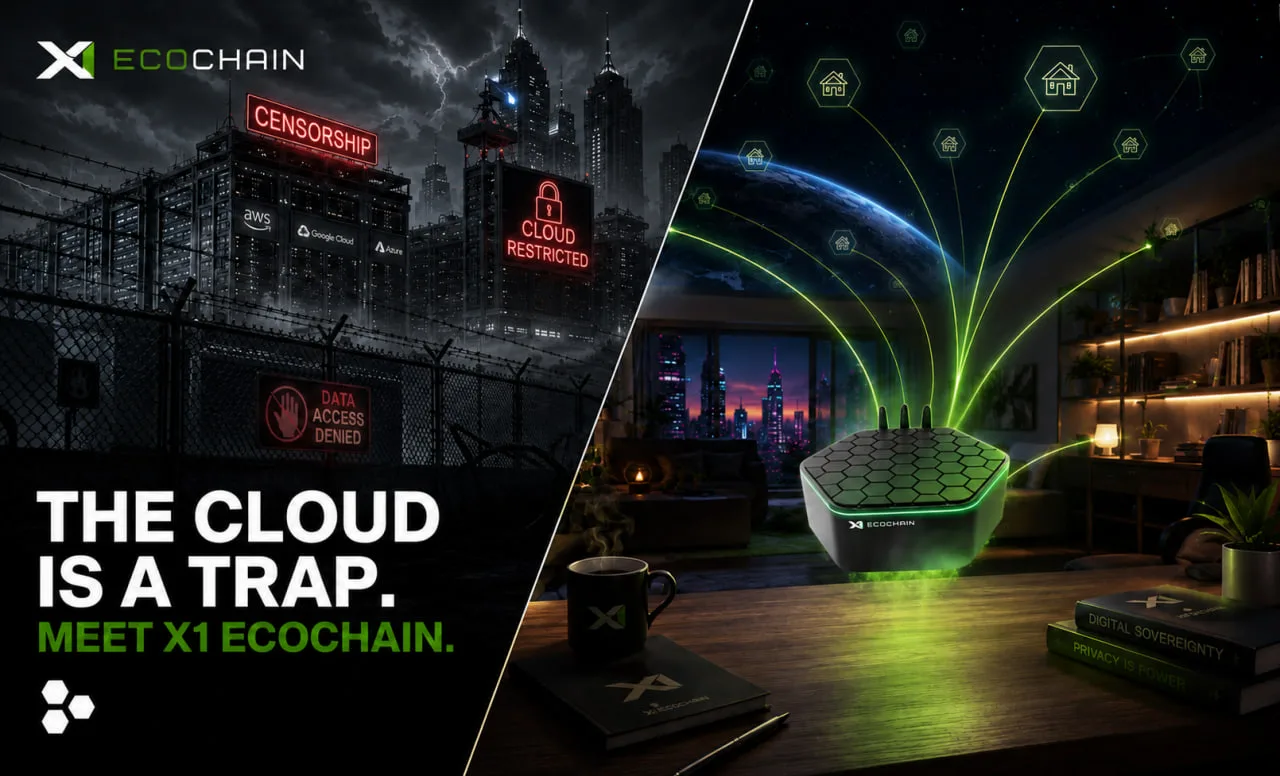
June 2026 has definitively divided the distributed ledger industry into a "before" and "after." A recent, unprecedented export control incident by the US government—where Anthropic was ordered to block foreign nationals' access to its cutting-edge AI models within 90 minutes—exposed the critical vulnerability of centralized clouds. It revealed that over 70% of validators in major PoS networks physically rent their computing capacity from Big Tech providers (AWS, Google Cloud). A single government decision is now enough to isolate entire ecosystems from their infrastructure.
Against this backdrop, the global technology sector has begun a fundamental overhaul of security standards. To understand where capital is flowing, it is essential to return to first principles and fundamentally rethink what is blockchain in the era of the sovereign internet. True decentralization cannot exist solely at the software code level—it requires an independent physical foundation. When conducting a deep architectural analysis, a classic blockchain comparison clearly demonstrates the superiority of hardware-based DePIN networks over traditional server networks.
The Scaling Problem and the Crisis of Traditional Layer-1s
Most popular Layer-1 networks were built in laboratory-like conditions, where the main challenges were transaction speed (TPS) and gas costs. However, the modern realities of Web4—where autonomous AI agents and IoT devices are becoming the primary consumers of traffic—have introduced fundamentally new requirements for ecosystems.
Any objective blockchain comparison exposes three core issues within legacy architectures:
Geopolitical Fragility: AI models and smart contracts deployed on centralized servers are completely subject to the laws and jurisdictions of the hosting provider.
The Energy Deadlock: Scaling heavy neural networks while maintaining consensus in classic blockchains demands colossal amounts of electricity, leading to soaring industrial costs and carbon footprints.
Economic Barriers: Volatile gas fees make it impossible to execute millions of Machine-to-Machine (M2M) microtransactions, where robots need to pay each other fractions of a cent to exchange data or rent memory.
When investors and developers ask what is blockchain today, the answer is shifting away from speculative tokens toward tangible physical utility. This is precisely where X1 EcoChain enters the spotlight.
X1 EcoChain: Next-Generation Sovereign DePIN
The X1 EcoChain network offers the market an alternative evolutionary path, completely shifting the interaction between software and the distributed ledger to independent, user-owned hardware. Unlike legacy projects, this ecosystem functions on top of a global Decentralized Physical Infrastructure Network (DePIN).
Instead of renting servers from tech giants, the X1 EcoChain blockchain runs on thousands of user-owned devices—X1Nodes—installed in ordinary homes worldwide. Such a flat mesh network is physically impossible to shut down from a single regulatory office.
When making a technological blockchain comparison, three key metrics position X1 EcoChain as a leader of the new cycle:
The 3-Watt Physics: Each residential X1Node consumes just 3 Wh —on par with a standard smartphone charger. This completely solves the energy efficiency bottleneck when scaling Web4 applications.
Low Fees (<$0.01): Consistently low transaction costs allow AI agents to seamlessly and continuously exchange data, trade tokenized datasets, and execute micropayments without financial friction.
Architectural Maturity and Ecosystem: The X1 EcoChain network is actively developing during its testnet phase. Recently, the project successfully concluded its second season of Streak Wars activities and fully deployed the ZNS Connect decentralized identity platform, enabling domain name minting across over 50 chains.
The geopolitical events of mid-2026 have proven beyond doubt that centralized cloud services can no longer guarantee operational stability. The only way to protect global tech projects from sudden blackouts is to build independent, decentralized networks. By launching a network of ultra-efficient residential nodes, X1 EcoChain is laying a robust foundation for a truly free, censorship-resistant, and economically accessible digital future.