
The future of the digital economy has arrived, but it is distributed unevenly. While retail investors look for market directions on trading charts, whales and tech visionaries are focusing on a fundamental tectonic shift: the inevitable convergence of artificial intelligence and decentralized networks.
We are officially entering the Web4 era—a paradigm where the primary economic actors are no longer humans, but autonomous AI agents. These programs need distributed environments to run computations, verify data, and exchange value without seeking approval from legacy banks. At the intersection of these operational needs, an entirely new tech stack is being forged where ai and blockchain function as a unified system. However, the ultimate battle will not take place in software; it will be fought at the physical hardware layer.
The Architectural Crisis: Why Legacy Web3 Cannot Handle Smart Machines
Let's admit the obvious: the vast majority of existing L1/L2 blockchains were engineered for manual financial transfers and retail speculation. They are physically unequipped to power a high-velocity machine economy.
What it all leads to:
Centralized Clouds (AWS / Google) ──> Risk of AI Model Censorship & Biases
Fluctuating Gas Fees (Ethereum) ──> Economic Collapse of M2M Payments
When technology companies attempt to merge blockchain and ai, they instantly hit severe cost and centralization barriers. Imagine an autonomous AI agent executing a micro-task like a data analysis check worth $0.01, but being forced to pay a $5 gas fee on Ethereum just to settle the result. This faulty math kills the entire Machine-to-Machine (M2M) economy at its roots.
Even worse is the hidden centralisation. Almost all validators on popular PoS networks rent their servers from Amazon Web Services or Google Cloud. If these tech giants decide to tighten regulations, the entire "decentralized" sector can be switched off with a single keystroke. True, sovereign artificial intelligence demands a physically independent, bulletproof foundation.
The X1 EcoChain Breakthrough: A Manifesto for Carbon-Neutral DeAI
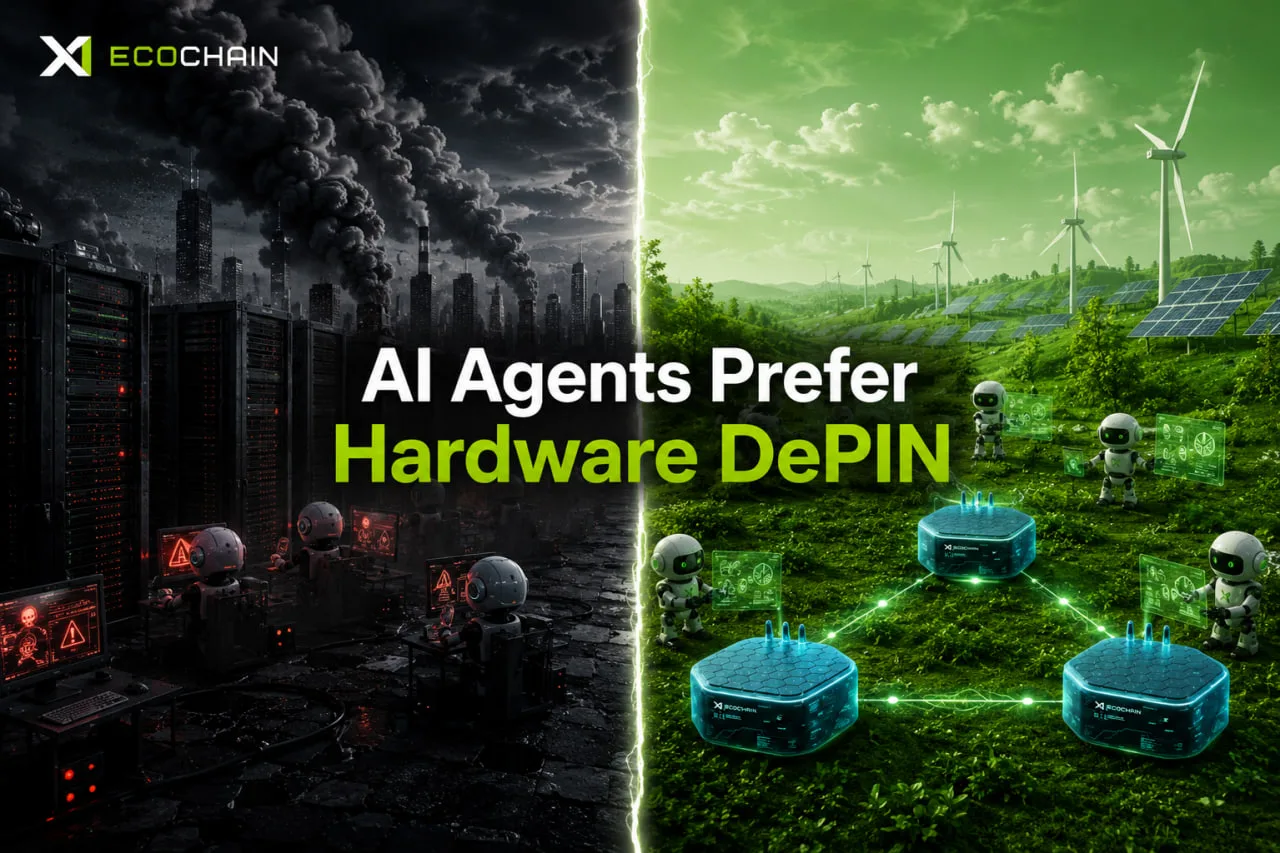
X1 EcoChain moves the concept of ai and blockchain out of theoretical debate and directly into the material world. Instead of outsourcing server capacity to corporate data centers, the network deploys directly onto thousands of independent, user-owned hardware units—X1Nodes—running silently inside homes.
The Physics of 3-Watt Consensus
Rather than burning terawatts of electricity (like PoW) or allowing virtual capital concentration (like PoS), X1 EcoChain implements a unique consensus algorithm called Proof-of-Nodes (PoN). The security of the network is maintained by the geographical distribution of thousands of micro-computers.
Each individual X1Node draws a mere 3 Wh of power—equivalent to a standard smartphone charger. This entirely eliminates the climate crisis, as pairing energy-hungry neural networks with legacy, "dirty" mining chains is a direct path to an energy collapse. Furthermore, the nodes come equipped with built-in eSIMs; if local broadband infrastructure suffers a regional outage, the network continues to sign blocks and route data seamlessly via backup mobile channels.
Fueling the Machine Economy: Sub-Cent Transaction Fees
Real synergy within the blockchain and ai sector is only possible when backed by a highly predictable, ultra-cheap infrastructure. The underlying architecture of X1 EcoChain drops transaction costs down below $0.01.
This opens the floodgates for seamless, real-time interactions across ai and blockchain frameworks. Millions of smart sensors and localized LLM agents can instantly process micropayments, buy decentralized compute units, rent storage space, and trade tokenized datasets simultaneously.
Additionally, X1 EcoChain’s immutable ledger solves the AI industry's greatest vulnerability—data poisoning. Developers can cryptographically stamp and verify model training logs directly on-chain, ensuring that final deployed algorithms have not been tampered with or modified by malicious third parties.
A New Paradigm for Digital Sovereignty
The integration of distributed physical networks and neural computing is more than just a temporary hype trend; it is the physical foundation for the sovereign internet of tomorrow. The blockchain is transitioning from a playground for speculative tokens into a secure cryptographic coordination layer, while the physical DePIN powered by 3-Wh home X1Nodes serves as its material manifestation. In a world where algorithms are beginning to dictate physical processes, the only networks that will survive are those that cannot be censored, shut down, or monopolized from a single central point.