
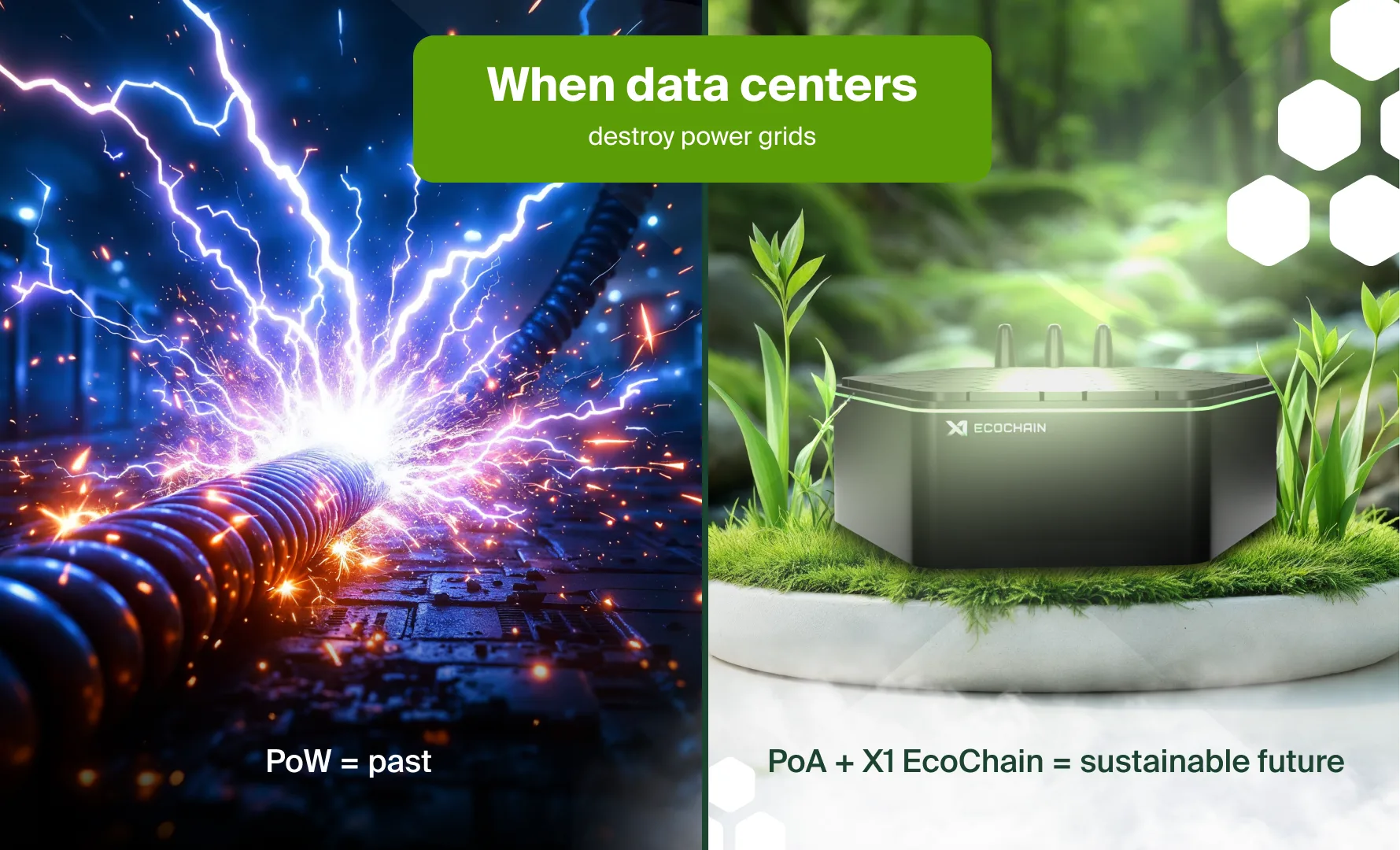
In mid-2025, residents of the U.S. state of Virginia witnessed an incident that until recently seemed impossible. In Data Center Alley — the largest cluster of data centers in the United States — around 60 data centers, including crypto-mining farms, suddenly went offline.
How Data Centers Overload Energy Systems
Data centers have evolved from technical facilities into critical elements of the power grid. But their growth and concentration in the same regions create vulnerabilities that traditional energy infrastructure struggles to manage.
· High consumption density. Clusters like Data Center Alley demand over 1.5 GW of power — the same as a city of about one million residents. And that’s just one region; dozens of similar hubs exist worldwide.
· Avalanche effect. When dozens of data centers shut down simultaneously, the grid faces sudden power surges. This can trigger a domino effect, leading to mass outages for both businesses and residents.
· Mining as a catalyst. Proof-of-Work (PoW) mining worsens the problem. Mining farms run equipment 24/7, devouring energy resources that could otherwise serve industry or households.
· Rigid infrastructure. Traditional data centers lack the flexibility to adjust power consumption dynamically. Designed for stable loads, they respond poorly to sudden demand fluctuations, leaving power grids hostage to their high, inflexible consumption.
Why Proof-of-Work Makes Things Worse
Proof-of-Work (PoW), the foundation of early cryptocurrencies, has become a serious challenge to both energy systems and the environment.
· Enormous energy demand. Estimates show that the Bitcoin network alone consumes over 130 TWh annually — on par with the energy use of an entire country like Argentina. This is a massive strain on the planet.
· Mining centralization. Farms cluster in regions with cheap electricity, overloading local grids and causing localized crises, like the Virginia incident.
· Computational inefficiency. All this energy is spent solving “puzzles” with no practical societal value. Billions of kilowatt-hours are wasted, leaving behind only CO₂ emissions and skyrocketing electricity bills.
Lessons from the 2025 Crisis
The Virginia incident was not just a technical failure — it was a wake-up call for the entire industry.
· Critical dependence on data centers. A single regional failure can trigger cascading problems across a national grid.
· Lack of true decentralization. Despite claims of being “decentralized,” PoW networks in practice rely heavily on massive mining clusters.
· Rising energy dependency of crypto. In an era of global energy transition, such demand is not only unethical but also dangerous for economies.
· Urgency of new solutions. The incident highlighted that PoW as a foundational model is becoming obsolete. The future belongs to energy-efficient, resilient architectures.
How X1 EcoChain Solves the Problem
X1 EcoChain introduces a new blockchain standard: Proof-of-Nodes (PoN). This is not just a technical alternative — it’s a fundamental rethinking of decentralization and energy efficiency.
· Minimal energy use. Each X1Node consumes only 3 Wh — comparable to charging a smartphone. Even thousands of nodes combined create a negligible load compared to a single PoW mining farm.
· Sustainability by default. No massive farms or centralized data centers are needed, eliminating emissions and ecological damage.
· True decentralization. Nodes are distributed worldwide and owned by users, not corporations, avoiding concentration risks like those in “data center alleys.”
· Scalability and flexibility. Load is evenly distributed, and the network scales seamlessly as more nodes join — without creating stress points for power grids.
· A new industry standard. X1 EcoChain proves that blockchain can be energy-efficient, resilient, and secure — without sacrificing speed or decentralization.
Conclusion
The Virginia crisis is a stark warning. If the industry continues to rely on centralized data centers and PoW farms, we face more blackouts, rising electricity costs, and environmental disasters.
But there’s hope. X1 EcoChain demonstrates that blockchain can be green, sustainable, and truly decentralized.
Transitioning from energy-hungry PoW networks to PoN isn’t a matter of trend — it’s a matter of survival. If we want technology to serve society, we need new architectures. And X1 EcoChain is leading the way.