
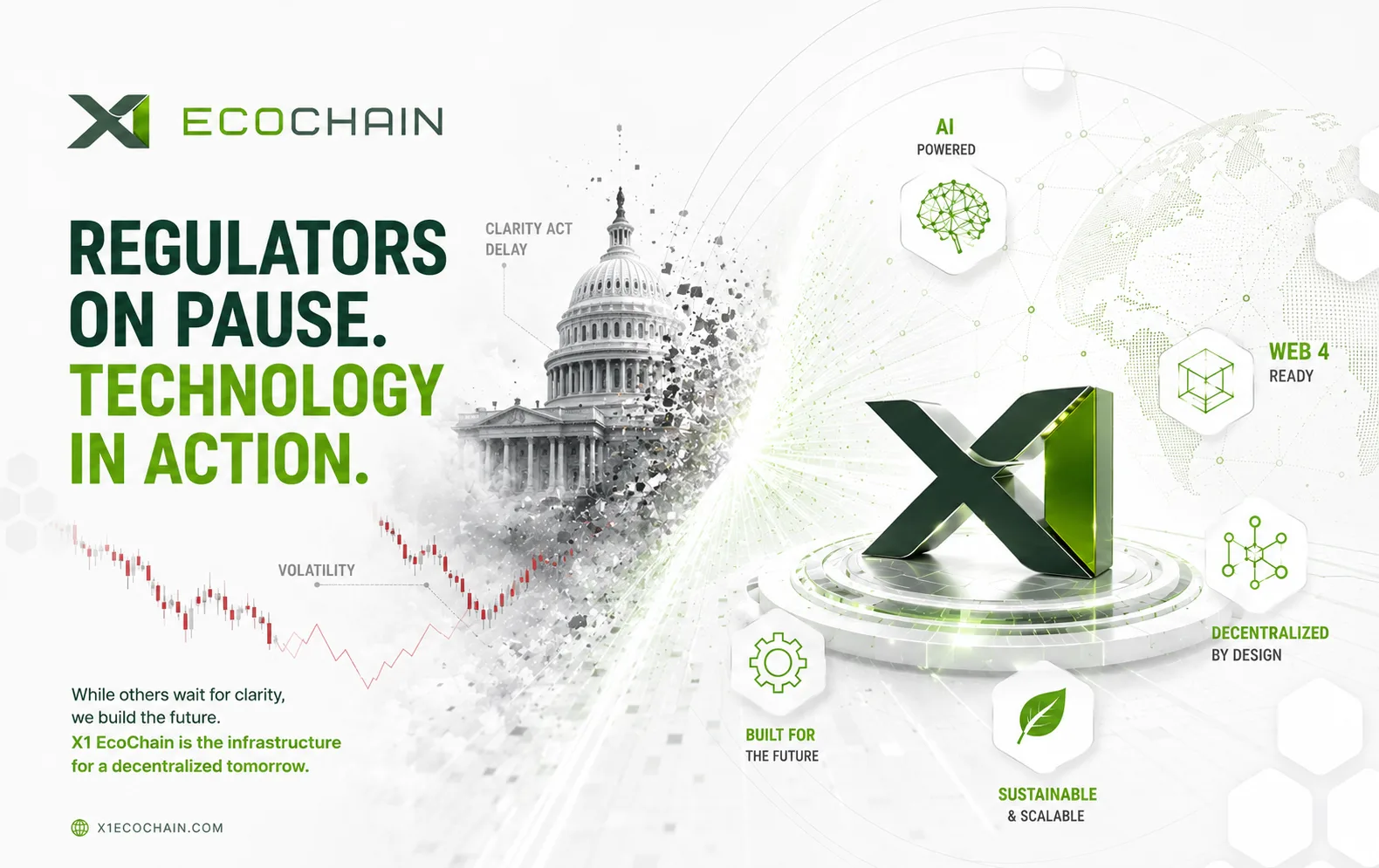
The end of July 2026 has brought new challenges for digital asset industry participants. Global crypto community attention is currently focused on the US, where the Senate decided to postpone consideration of the key bill, the CLARITY Act. This document was intended to clearly delineate the regulatory authority between the SEC and CFTC and provide legal clarity for institutional investors. The vote delay—amid expectations surrounding the Federal Reserve's interest rate decision—triggered short-term volatility: Bitcoin entered a consolidation phase around the $63,000 mark, while altcoins experienced a moderate correction.
Despite external macroeconomic factors, the fundamental development of Web3 infrastructure continues at a rapid pace. The current period clearly demonstrates that while large capital flows have stalled awaiting regulatory decisions, technological Layer-1 networks are actively developing their services.
Technological Vector: The Convergence of Artificial Intelligence and Blockchain Systems
Parallel to financial news, the main technological trend of summer 2026 has been the active development of autonomous services and AI agents. Market experts note that the synergy of AI and blockchain opens up opportunities for creating transparent prediction markets and autonomous digital asset management.
Developers are increasingly integrating algorithms into decentralized environments. Utilizing a combination of blockchain and AI automates trading strategies and microtransactions, minimizing human error and simplifying the user experience.
Conducting expert blockchain comparison analysis, analysts emphasize that legacy networks often lack the speed and low transaction costs required to process regular queries from neural network agents. In this regard, regular blockchain comparison plays a key role: investors and dApp developers choose architectures capable of sustaining high, continuous loads with minimal fees.
The industry is proving that the right integration of blockchain and AI sets an entirely new standard for applying smart algorithms in the Web4 space. In turn, a well-structured connecting layer of AI and blockchain frees users from needing to interact directly with complex cryptographic interfaces.
Architectural Response: AI Agent Needs and Solutions from X1 EcoChain
It is precisely at the intersection of these trends that the role of high-tech Layer-1 networks becomes clear. Autonomous AI agents and high-load services require infrastructure capable of processing thousands of micro-operations without failures or gas fee spikes.
In this context, X1 EcoChain acts as the fundamental layer addressing the core needs of the new generation of dApps:
Scalability and Overload Protection: The architecture is optimized for frequent automated requests, allowing algorithms to execute transactions in real time.
Energy Efficiency and Eco-Standards: The network's eco-friendly consensus reduces the carbon footprint, which is critical for institutional partners and developers deploying AI solutions.
Lowering the Barrier to Entry: Support for native domain services and intuitive interfaces masks complex cryptography, making blockchain interaction as simple as using a standard web application.
While the global market reacts to regulatory pauses, foundational projects—such as X1 EcoChain—are building the technological base required to transition from simple smart contracts to fully autonomous ecosystems.