
The modern digital landscape is undergoing a massive structural transformation. Two of the most dominant technological mega-trends—artificial intelligence and distributed ledgers—are no longer evolving in isolation. Instead, their synergy is forging an entirely new technological stack.
However, to understand the depth of this shift, one must return to the fundamentals and clearly address a core question: what is blockchain? In its foundational sense, it is a tamper-proof, decentralized database that guarantees trust between participants without relying on intermediaries. Yet, when we attempt to deploy resource-heavy intelligent computations on top of this framework, legacy architectures hit severe physical limits. The X1 EcoChain project solves this fundamental bottleneck, building a sovereign environment for Decentralized AI (DeAI) by integrating smart algorithms with distributed hardware networks.
The Architectural Bottleneck: Why Legacy Web3 Cannot Support the AI Evolution
Any deep technical blockchain comparison demonstrates that the vast majority of existing Layer-1 and Layer-2 networks were engineered in an era of simple financial transactions. They are inherently unequipped to handle the heavy workloads generated by modern autonomous agents and neural networks.
Infrastructure Bottlenecks of Legacy Networks when Handling AI:
Centralized Clouds (AWS / Google): Lead to high risks of censorship, regional blockages, and operational biases in AI models.
High and Fluctuating Gas Fees: Lead to the complete economic collapse and unviability of automated machine-to-machine (M2M) microtransactions.
When analyzing the intersection of fields like blockchain and ai, infrastructure cost becomes the ultimate barrier to entry. If an autonomous agent is forced to pay several dollars in gas fees for a simple logical operations check or data validation task on Ethereum, the entire economic framework of Machine-to-Machine (M2M) interaction instantly degrades.
Furthermore, conducting a standard blockchain comparison exposes a hidden centralisation flaw: most PoS validators lease their infrastructure from the same three or four tech giants. If an AI model is ultimately reliant on AWS or Google Cloud servers, proclaiming its true sovereignty or censorship-resistance is functionally meaningless.
A New Standard of Convergence: Integrating AI and Blockchain
To meet the demands of the new digital era, we must completely re-engineer how distributed ledgers and neural networks interact. The real breakthrough at the crossroads of ai and blockchain occurs when the blockchain evolves beyond a simple payment rails layer into an immutable coordination layer for computational workloads.
The DeAI Infrastructure Stack
The core framework is divided into two distinct operational layers:
1. Cryptographic Layer
Dataset Verification: Ensures the integrity of training logs and protects AI models from data poisoning.
Sub-Cent Fee Metrics (< $0.01): Keeps transaction overhead minimal, making automated machine-to-machine micropayments economically viable.
Deploying sovereign decentralized frameworks solves one of the AI industry's most critical vulnerabilities—data poisoning and the lack of black-box training transparency. By leveraging cryptographic validation mechanisms, developers gain the ability to verify training logs and data origins directly within a distributed ledger.
This synchronization across blockchain and ai design structures allows automated programs to exchange datasets securely without fearing centralized server manipulation. However, powering this ecosystem requires a radically different hardware solution.
The X1 EcoChain Breakthrough: A Manifesto for Physical DeAI
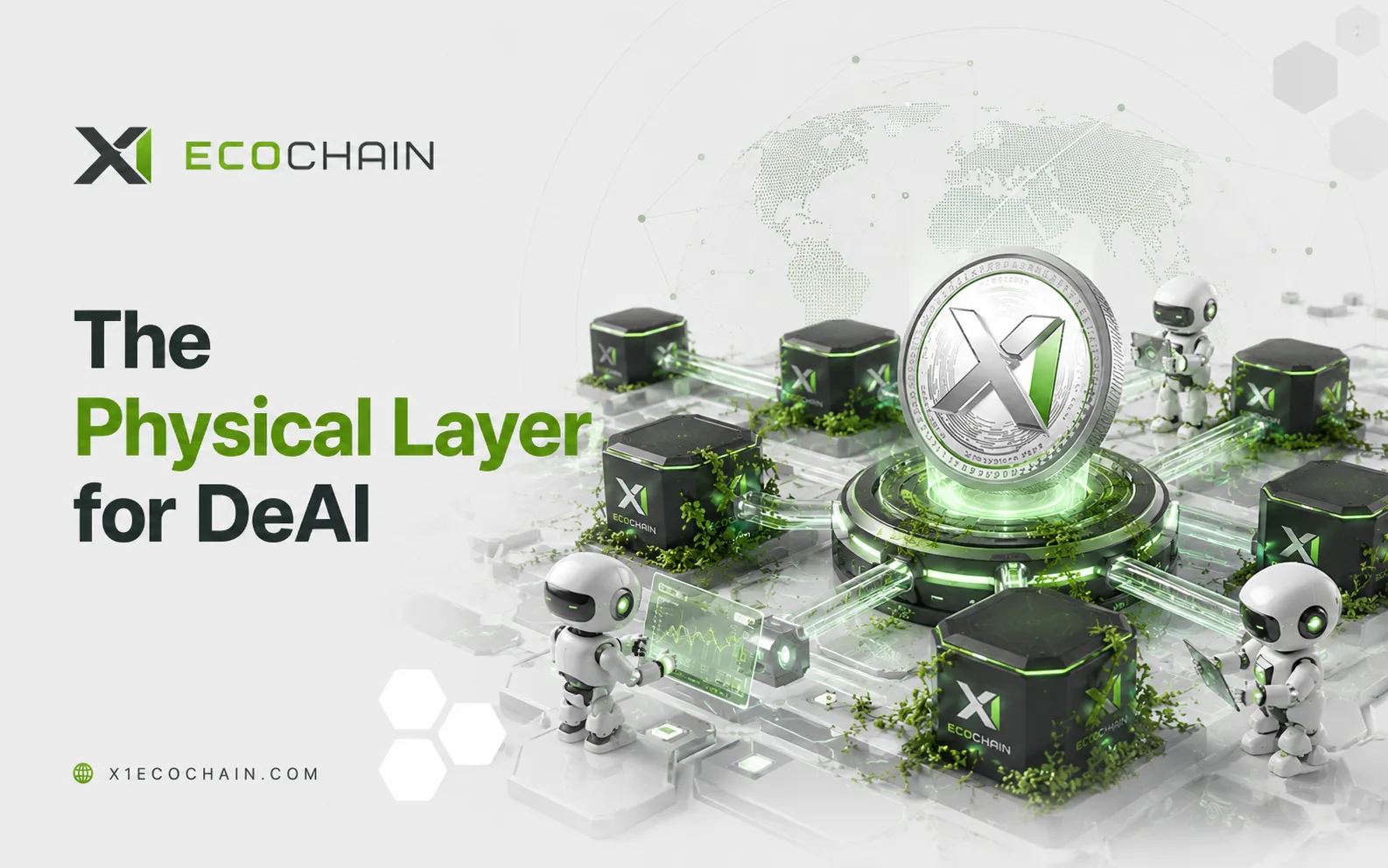
The X1 EcoChain project brings the theoretical narratives of its Whitepaper into the physical world, constructing the world's first green, hacker-resistant foundation for DeAI. Instead of outsourcing server capacity to Big Tech, the EcoChain network deploys directly onto thousands of independent, user-owned hardware units—X1Nodes.
1. Proof-of-Nodes (PoN) Replaces Energy-Intensive Consensus
To truly capture what is blockchain in the next generation of tech, one must inspect its consensus design. Rather than burning terawatts of electricity via Proof-of-Work (PoW) or allowing virtual capital concentration via standard Proof-of-Stake (PoS), X1 implements Proof-of-Nodes (PoN). Here, network security and consensus are maintained by the physical, geographical distribution of micro-hardware units operating silently inside users' homes and offices worldwide.
2. The Physics of 3-Watt Micro-Hardware
Each physical X1Node is built as a compact, consumer-ready appliance:
Ultra-Low Energy Consumption: Each device draws a mere 3 Wh of power—equivalent to a standard smartphone charger. This entirely eliminates the massive carbon footprint that typically occurs when pairing AI demands with legacy mining hardware.
Mesh Topology: The network operates as a flat P2P framework with no privileged supernodes. The ledger state and smart contracts are fully sharded and replicated globally.
Independent Routing: Outfitted with built-in eSIM modules, these nodes can route traffic and sign blocks over secure mobile backup frequencies if local broadband infrastructure experiences regional outages.
The Economic Fabric for Autonomous Agents
The direct byproduct of deploying this decentralized physical infrastructure is a radical reduction in transaction overhead. On-chain execution fees within X1 EcoChain settle below $0.01, providing a sustainable green light for the scaled convergence of ai and blockchain technologies.
Autonomous algorithms, smart city sensors, and IoT ecosystems can seamlessly process millions of microtransactions per second—purchasing decentralized compute units, renting storage space, and swapping tokenized assets in real-time.
By eliminating central server intermediaries from the equation, the core definition of what is blockchain expands significantly. It ceases to be a tool for mere speculation and matures into a tangible, carbon-neutral, and sovereign nervous system for the artificial intelligence of tomorrow.