
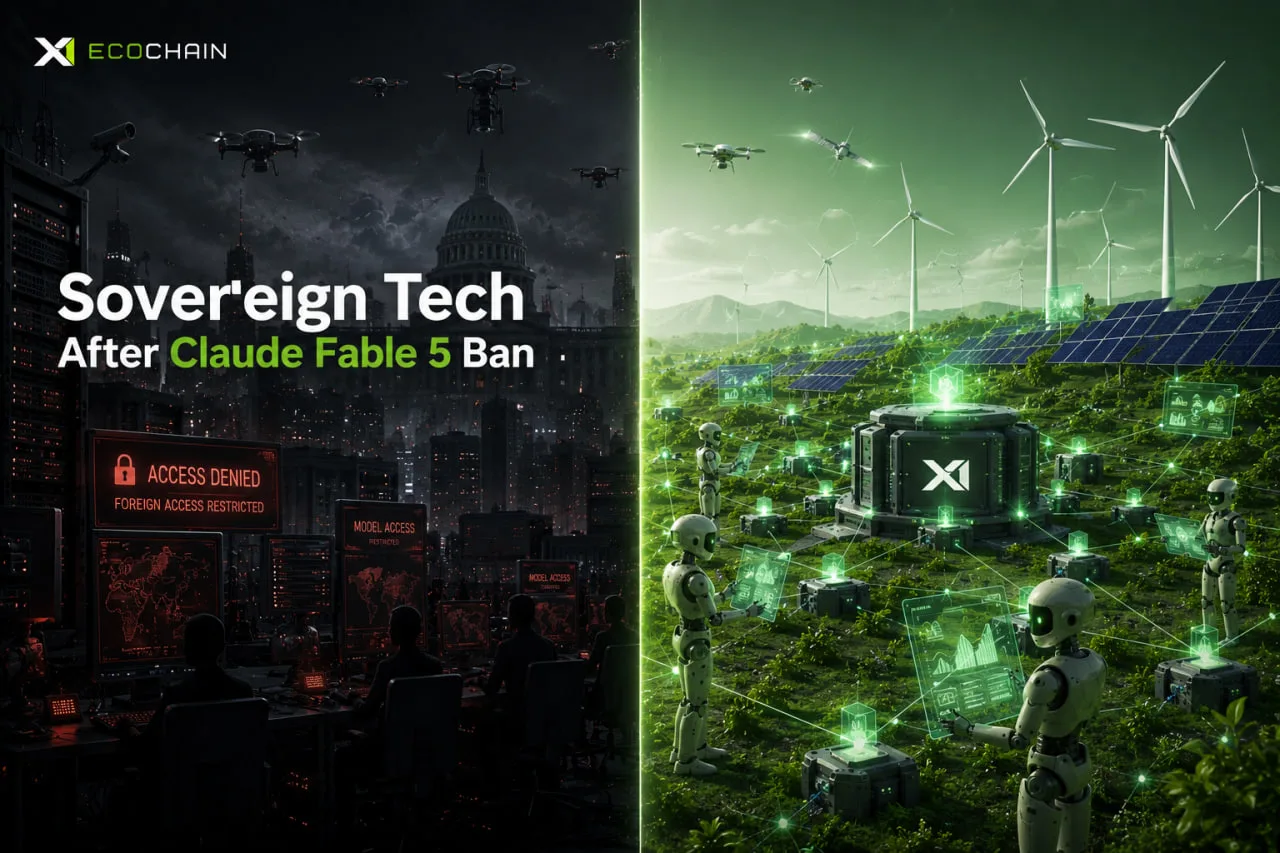
June 2026 will go down in history as the exact moment technological sovereignty stopped being an abstract talking point. The sudden incident involving Anthropic—where the U.S. Department of Commerce blindsided the industry by giving the company a mere 90 minutes to cut off all foreign nationals from its new flagship Claude Fable 5 and Mythos 5 models—sent shockwaves through the global tech sector.
Because screening hundreds of millions of users by nationality in real time is operationally impossible, Anthropic had to abruptly disable the models globally, leaving thousands of startups and global researchers stranded. This unprecedented regulatory intervention proved one clear point: if your innovations rely entirely on centralized Big Tech clouds (AWS, Google Cloud), your entire enterprise can be dismantled with a single government memo. In light of this fallout, the industry is waking up to the urgent need for alternative architectures, where the convergence of blockchain and ai can guarantee physical immunity from geopolitical intervention.
The Illusion of Decentralization and the Cloud Hosting Crisis
Most modern developers treat artificial intelligence and distributed ledgers as purely software-based solutions. However, the physical reality of hardware cannot be ignored. By trying to build hybrid networks on top of legacy frameworks, technology companies continually run into the same centralization barriers.
Nearly 70% of validators on top PoS networks rent their computing capacity from a highly concentrated pool of providers, heavily dominated by Amazon Web Services. When complex neural networks are deployed on such an unstable foundation, the entire apparatus becomes deeply fragile. Relying on blockchain and ai setups within legacy Web3 frameworks introduces two systemic bottlenecks:
Infrastructure Dictatorship: Any model hosted inside a centralized server is entirely bound to the laws of that server's physical jurisdiction. The Anthropic precedent proved that regulators can restrict access to code faster than core developers can ship a software patch.
Economic Stagnation: Trying to link autonomous machine agents with legacy networks (like Ethereum) to secure training logs or execute Machine-to-Machine (M2M) settlements fails due to volatile gas fees. A software agent cannot logically pay a $5 gas fee for a transaction worth less than a cent.
The X1 EcoChain Alternative: Claiming Silicon Sovereignty via DePIN
The clear path forward requires moving entirely away from corporate cloud monopolies and transitioning toward physically sovereign setups. The X1 EcoChain ecosystem relocates the synergy of blockchain and ai from basic software integrations directly down to independent hardware, deploying a highly resilient Decentralized Physical Infrastructure Network (DePIN).
Instead of outsourcing data hosting to tech conglomerates, the X1 EcoChain architecture runs on thousands of independent, user-owned physical devices called X1Nodes, operating inside private homes worldwide. This flat, decentralized mesh network cannot be shut down from a single corporate office or government building.
Furthermore, X1 EcoChain addresses the critical scaling pain points of cost and energy consumption:
Proof-of-Nodes (PoN) Consensus: Network security and block validation are maintained through geographic hardware distribution rather than burning massive amounts of electricity.
The 3-Watt Physics: Every home-based X1Node sips a mere 3 Wh of power—roughly the same as a standard mobile phone charger. This resolves the carbon footprint issues that usually plague scaling neural networks.
Sub-Cent Fees (<$0.01): Predictable micro-fees allow millions of independent software agents to securely trade tokenized datasets, rent localized storage, and process real-time M2M payments without financial drag.
The sudden U.S. export control mandate against Anthropic has signaled that geography and nationality have officially entered the software layer. The only definitive way to shield global innovation from political shifts is by building a Web4 architecture anchored to independent hardware. By running low-power, 3-watt nodes from home, everyday users are becoming the physical foundations of a free, open, and un-censorable digital economy.