
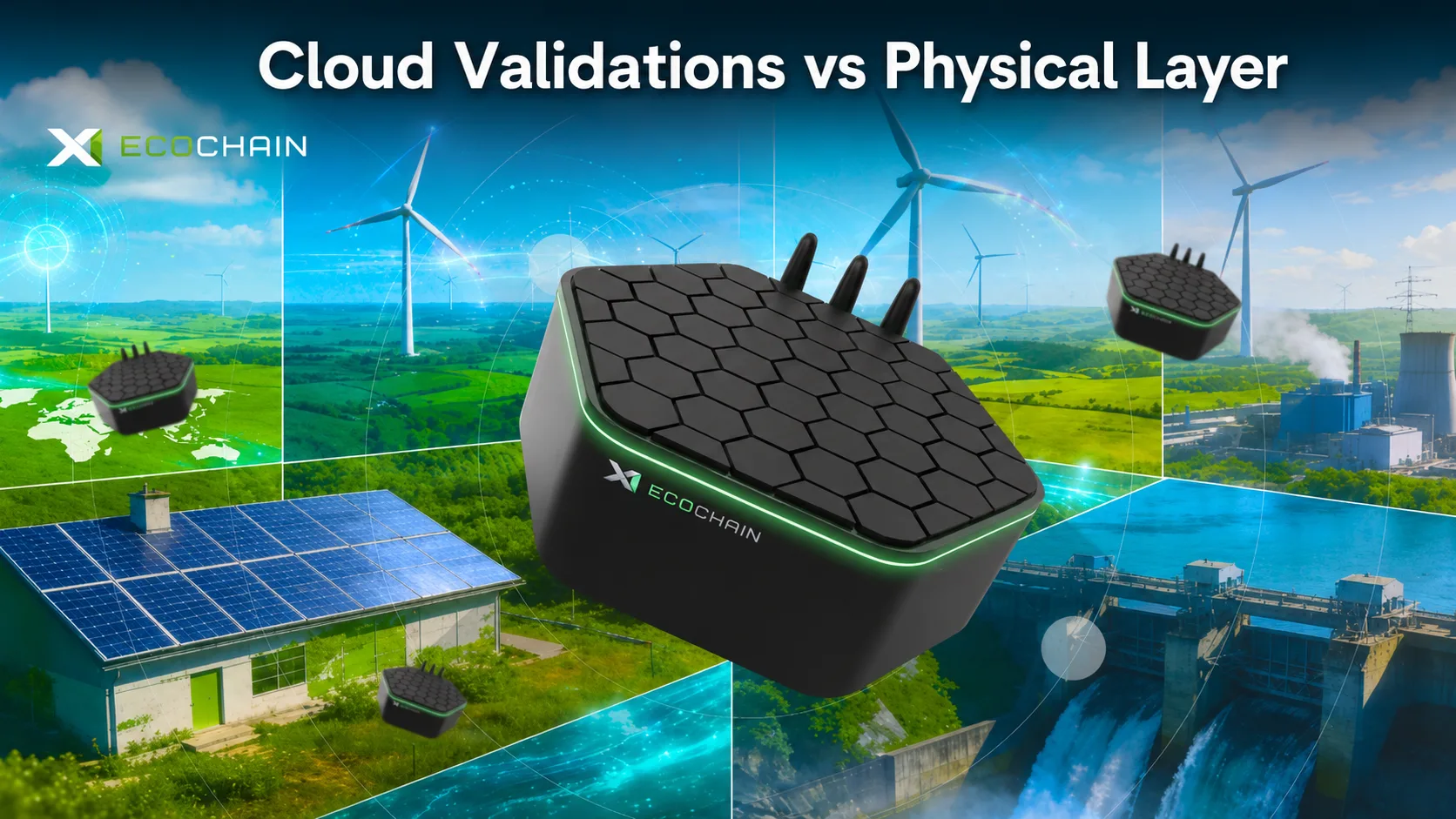
The architecture of distributed ledgers is facing an infrastructural turning point. For years, the metric of a network's success was measured purely in transactional throughput or speculative liquidity. However, as automated computations and heavy data protocols become the primary drivers of digital traffic, the underlying physical layer of these networks has exposed severe environmental and centralization bottlenecks. A comprehensive blockchain comparison reveals that the industry can no longer ignore the physical reality of where nodes are hosted and how much power they consume.
To solve this, a new paradigm is shifting the industry away from data-center monopolies and resource-intensive validation methods. The X1 EcoChain addresses these flaws directly by anchoring its infrastructure into low-powered, 3-watt hardware nodes, creating a green, sustainable foundation for the future of decentralized networks.
The Energy Crisis: 3-Watt Micro-Hardware vs Industrial Mining
When analyzing network sustainability, a strict blockchain comparison requires looking at the raw physics of consensus mechanisms. Traditional protocols operate on a model of scale that scales proportionally with environmental destruction or high corporate overhead.
Energy Consumption Metric (Per Node / Unit):
Bitcoin ASIC: 3,000+ Wh ──> High Carbon Footprint / Industrial Monopolies
Standard PoS Server: 400+ Wh ──> Reliant on Centralized Cloud Data Centers
X1Node Infrastructure: 3 Wh ──> Runs on Smartphone-Charger Levels of Power
Proof-of-Work (PoW) networks like Bitcoin rely on hyper-competitive computational racing. To secure the ledger, industrial mining facilities must burn thousands of megawatts per hour, turning blockchain security into a heavy burden on global energy grids.
On the other hand, while Proof-of-Stake (PoS) networks eliminated the need for heavy mining rigs, a deeper blockchain comparison shows they merely traded an environmental crisis for a sovereignty crisis. Most PoS validators run their nodes on enterprise-grade servers hosted within centralized cloud architectures like AWS or Google Cloud, which draw roughly 400 Wh of continuous power per unit.
The X1 EcoChain architecture completely breaks this loop. By implementing the Proof-of-Nodes (PoN) consensus algorithm, the network runs entirely on independent physical devices called X1Nodes. Each node draws a mere 3 Wh of power—the exact same amount as a standard home internet router or a smartphone charger. This ultra-low footprint allows anyone to run a node from home, introducing a highly inclusive network that eliminates single points of failure without draining planetary resources.
Beyond Simple Integrations: Transitioning to True DeAI
As automated applications scale, the convergence of blockchain and ai has become a dominant trend in technology. However, there is a massive structural difference between how legacy chains approach this trend and how a purpose-built infrastructure operates.
Most standard platforms claim an alliance between blockchain and ai by simply acting as tokenized payment layers for centralized LLM (Large Language Model) APIs. In these setups, the actual intelligence, data processing, and model training still occur inside closed corporate data centers. This introduces massive risks of data manipulation, single-source censorship, and data poisoning.
The DeAI Infrastructure Evolution:
Legacy AI-Blockchains:
Simple payment layers for APIs
Heavy cloud data dependency
Vulnerable to central censorship
X1 EcoChain DeAI:
Decentralized Physical Infrastructure
Sub-cent fees (< $0.01) for M2M tasks
Cryptographic dataset verification
X1 EcoChain moves past these superficial integrations to deploy true Decentralized AI (DeAI). Instead of treating artificial intelligence as an external client, the X1 ecosystem provides the physical DePIN infrastructure necessary to host, verify, and run distributed AI workloads securely.
When evaluating these models through a thorough blockchain comparison, legacy protocols fail because their high or fluctuating gas fees make automated machine-to-machine (M2M) microtransactions financially impossible. X1 EcoChain maintains transaction fees under $0.01, allowing autonomous software agents to seamlessly trade data tokens, rent local computational units, and execute smart contracts at scale.
Furthermore, a permanent alliance between blockchain and ai systems requires absolute data integrity. By utilizing X1’s immutable ledger, developers can cryptographically stamp and verify training datasets directly on-chain. This ensures that the data driving autonomous decision-making models cannot be tampered with or corrupted by external third parties.
Architectural Agility for an Automated Future
Looking ahead, a technical blockchain comparison underscores that the networks capable of surviving the next decade must be physically sovereign. A system that can be turned off by a single corporate cloud provider or a regional energy mandate is not truly decentralized.
By combining an ultra-low energy footprint of 3 Wh with a flat P2P mesh topology, X1 EcoChain offers a resilient environment where thousands of independent home nodes secure the network. The convergence of blockchain and ai demands an infrastructure that operates seamlessly in the background, without massive capital barriers or heavy carbon emissions. By anchoring its protocol into user-owned hardware, X1 provides the secure, physical foundation that allows the global digital economy to scale safely, sustainably, and without borders.