
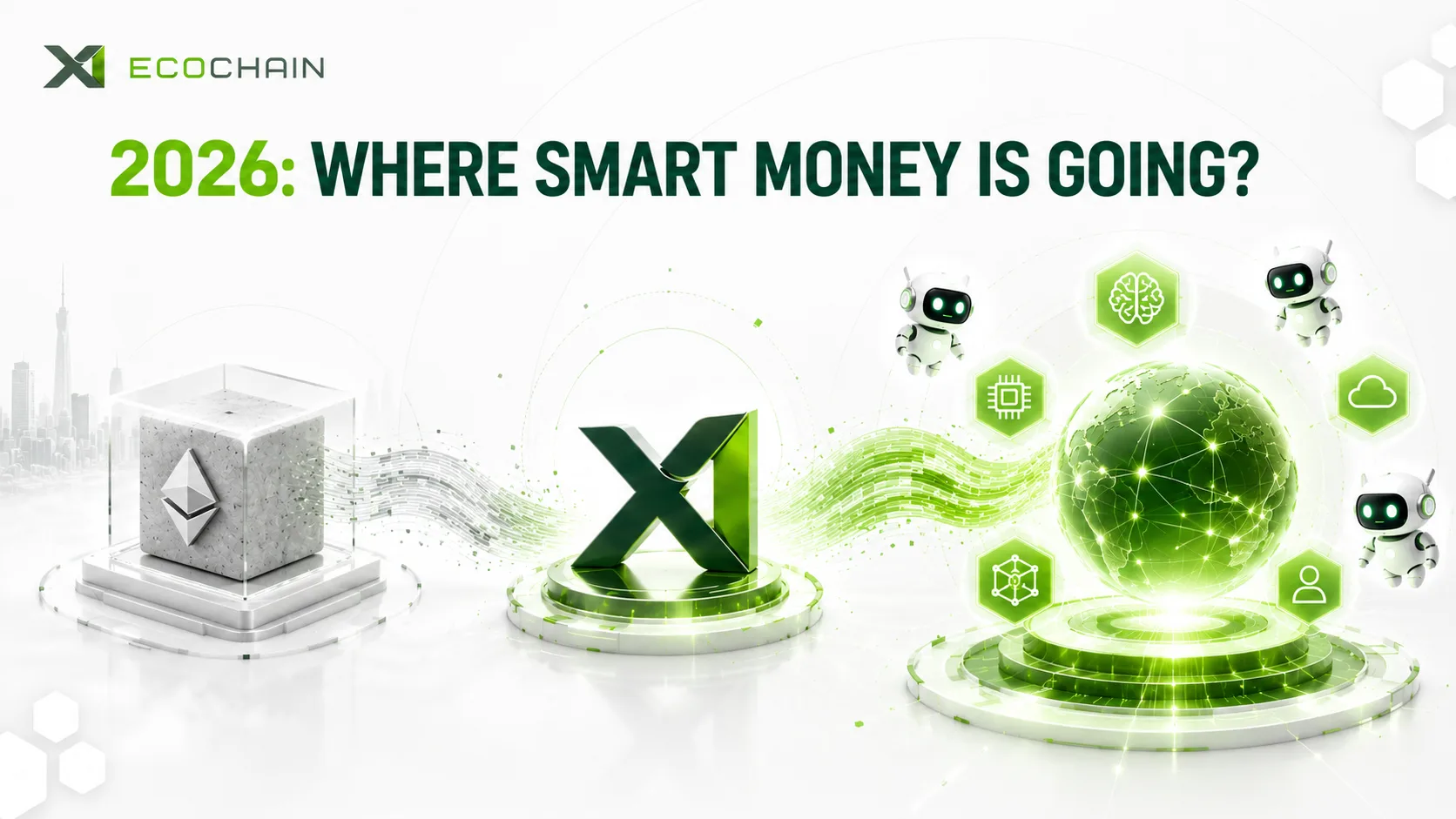
The end of July 2026 was marked by a new phase of institutional cryptocurrency integration. The headline news across global financial markets has been the entry of major Wall Street players into the staking product market. The launch of spot trusts with native yield generation options by the largest investment houses confirmed a key shift: investors are no longer interested in passive asset holding—the market demands functional infrastructure that yields real staking returns and maintains high network activity.
This shift coincided with a large-scale transformation in the architecture of Web3 applications itself, where autonomous services and hybrid technologies have begun to play a central role.
Technological Breakthrough: Integrating Intelligence into Decentralized Networks
Beyond news from traditional capital markets, the summer of 2026 will be remembered for the rapid advancement of the Web4 concept. The foundation of this trend has been the deep integration of neural network agents into the blockchain space.
Experts note that the concept of AI and blockchain has evolved from a theoretical trend into an industry standard. Today, autonomous algorithms are actively used for liquidity management, automating decentralized prediction markets, and processing large data sets without human intervention.
The industry has realized that the combination of blockchain and AI solves two problems at once: blockchain provides algorithms with a transparent environment and financial settlement layer, while AI frees users from having to manually perform routine on-chain operations.
However, for the connection of blockchain and AI to function without delays, baseline networks with the highest throughput are required. Conducting regular blockchain comparison has become a mandatory task for institutions and dApp developers.
A deep blockchain comparison shows that most legacy networks face the issue of high gas costs during frequent microtransactions initiated by AI bots. That is precisely why projects combining AI and blockchain technology with scalable Layer-1 code are gaining the greatest advantage in 2026.
The Role of X1 EcoChain in the New Infrastructure
Against the backdrop of market demand for high performance and staking efficiency, the X1 EcoChain blockchain demonstrates a ready-made solution for the next-generation ecosystem.
As a Layer-1 network based on the energy-efficient Proof-of-Nodes consensus, X1 EcoChain delivers the exact parameters required for interacting with autonomous agents and microtransactions:
High Speed and Minimal Gas: The network architecture is capable of processing a high frequency of requests without sudden fee spikes, which is critically important for bots and prediction markets.
Eco-Friendliness: Full compliance with ESG standards makes the network attractive to institutional partners deploying green validators.
User-Friendliness: The implementation of native tools (such as the .x1eco domain service) connects complex infrastructure into an intuitive interface for the mass user.
Summary: While Wall Street expands its lineup of passive-income crypto funds, technological platforms like X1 EcoChain are building the essential foundation upon which the entire decentralized economy of the future will operate.