
Supply Chains in Disarray
Within days, the unease spilled into public life. Asahi operates around thirty plants across Japan, and although production itself wasn’t directly affected, warehouses began to run dry. Convenience store chains like 7-Eleven, Lawson, and FamilyMart warned of supply disruptions: shelves would empty faster than anyone expected. The Guardian calculated that stocks of Asahi Super Dry could vanish in just a few days.
This was more than a temporary shortage of toilet paper or chips. This time, the hackers hadn’t stolen money, they had stolen a ritual, a small symbol of everyday life.
A Classic Ransomware Attack
The company issued a series of carefully worded statements. They acknowledged the possibility of unauthorized data transfers but reported no confirmed leaks of personal information. The language was cautious, but the signs were clear: a classic ransomware attack, locking down critical systems while demanding a ransom for their release. To soften the blow, Asahi set up an emergency response headquarters and shifted part of its operations to manual processing, prioritizing soft drinks and food shipments over beer.
Cultural Shock
For the Japanese, the blow was cultural as much as economic. Asahi beer is not just a product, it’s part of everyday life, woven into the after-work drinking ritual of nomikai. The sudden disappearance of Super Dry bottles struck not only at the company but at the national psyche. People realized how fragile their routines could be and how a single server failure could unravel a way of life.
The Fragility of Centralization
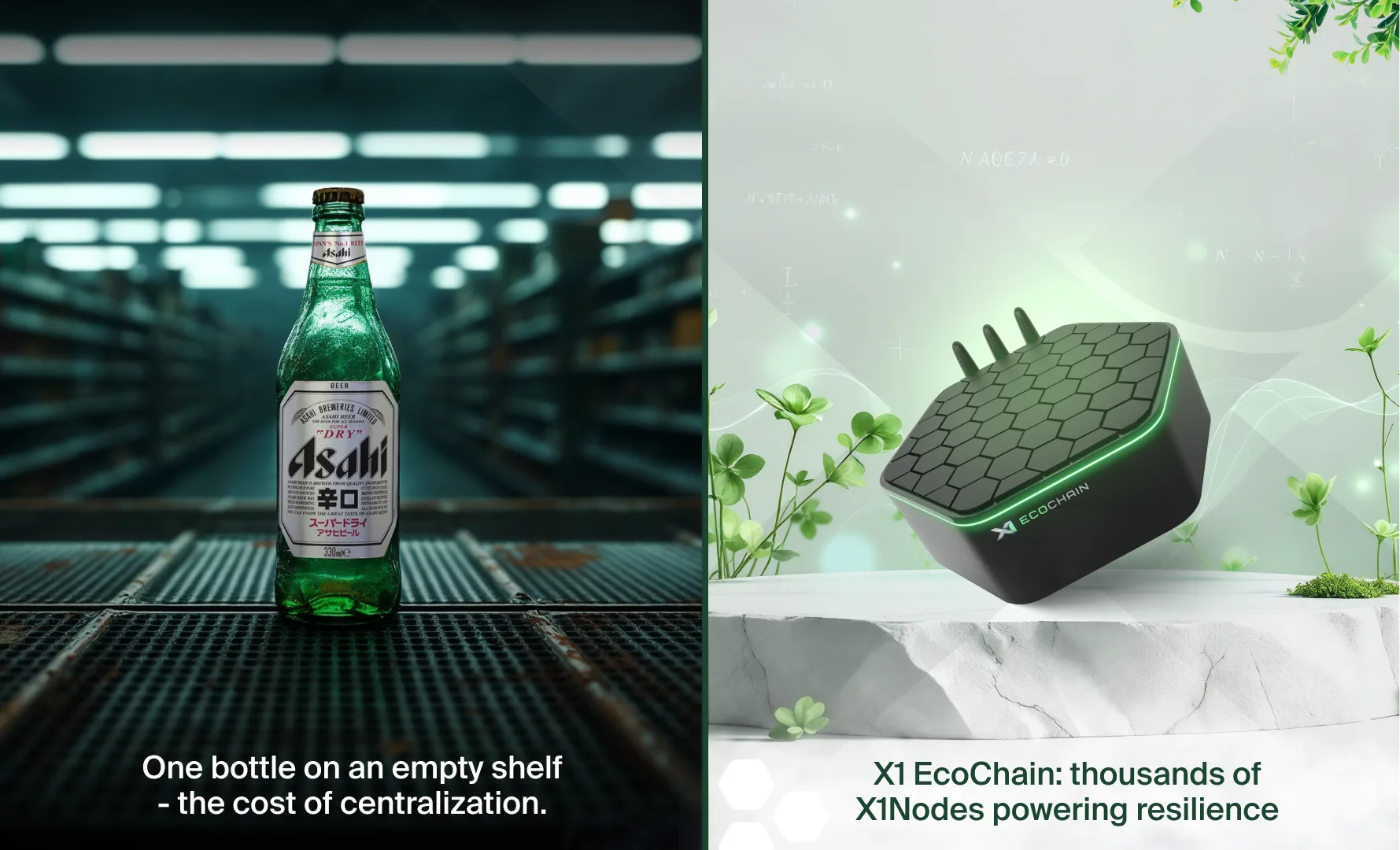
The lesson was hard to miss. Centralization is a beautiful illusion of control and efficiency, but it makes systems brittle. At Asahi, everything was tied to a few digital nodes, and when one of them was compromised, the whole organism was paralyzed. That’s why conversations about blockchain and decentralization feel so timely here.
A Decentralized Alternative
X1 EcoChain is built on a different principle. There is no single center, no button marked “OFF.” X1Nodes are small and energy-efficient consuming just three watt-hours each but because they are distributed across 65+ countries, together they form a living organism that cannot be silenced in one blow. This global distribution means that even if part of the network goes down due to local outages, cyberattacks, or regulatory restrictions, the rest of the system keeps functioning. Where Asahi experienced paralysis, a decentralized architecture like this adapts and keeps moving forward.
The Future of Resilience
The world now balances on a thin edge between viruses and smart contracts. On one side stand the hackers; on the other, the engineers building resilient networks. And in between are ordinary people who just want stability. Perhaps the future of business resilience lies not in centralized fortresses that can be toppled with a single strike, but in decentralized systems that breathe, adapt, and continue to function no matter what.