
Over the past fifteen years, blockchain technology has evolved from a marginal digital cash experiment into the foundation of decentralized finance. Yet, if we are being honest, Web3 has stopped just short of its main promise: absolute independence.
Today’s decentralization faces a severe identity crisis. Attempts to solve the classic trilemma—choosing any two attributes between security, speed, and decentralization—have forced the industry into dangerous compromises. An architecture designed for freedom has quietly migrated to centralized cloud servers like Amazon Web Services (AWS) and Google Cloud.
The new era, Web4, requires a fundamentally different approach. The internet of autonomous AI agents, the Internet of Things (IoT), and instant machine-to-machine microtransactions needs a physically independent, carbon-neutral foundation. This ecosystem is being built right now through the synergy of DePIN (Decentralized Physical Infrastructure Networks) and a new node-centric consensus mechanism. Let's explore the physics and economics behind this shift.
The Evolutionary Dead End of PoW and PoS
To understand the value of hardware-based decentralization, we must first look at the fundamental flaws of the current mainstream consensus algorithms.
Consensus Technology Evolution Pathways:
Stage 1: PoW (Proof-of-Work) — The era of energy consumption and industrial mining.
Stage 2: PoS (Proof-of-Stake) — The era of capital concentration and data center-hosted validators.
Stage 3: PoN (Proof-of-Nodes) — The era of physical micro-nodes operating in everyday users' homes.
1. Proof-of-Work (PoW): The Era of Industrial Mining
PoW taught the world to trust mathematical code, but its price is measured in terawatt-hours. Consensus here relies on brute force: to secure the network, miners must continuously burn electricity to compete for computing power.
This led to industrial centralization. Mining migrated to giant warehouses near cheap power plants, turning into a corporate playground. An average person with a home computer has long been pushed to the sidelines.
2. Proof-of-Stake (PoS): Digital Oligarchy in the Cloud
Seeking an eco-friendly alternative, the industry shifted to PoS, replacing energy consumption with capital locking (staking). While the environmental crisis eased, a sovereignty crisis emerged.
In PoS networks, the rule of "the rich get richer" dominates, as wealthy validators absorb the lion's share of issuance. Worse, to maintain uptime, 70–80% of major nodes rent servers from just three or four tech giants. If a cloud monopoly blocks these accounts due to geopolitical pressure, a massive chunk of the market goes offline. It is an illusion of freedom.
Redefining Hardware: How 3-Wh DePIN Networks Work
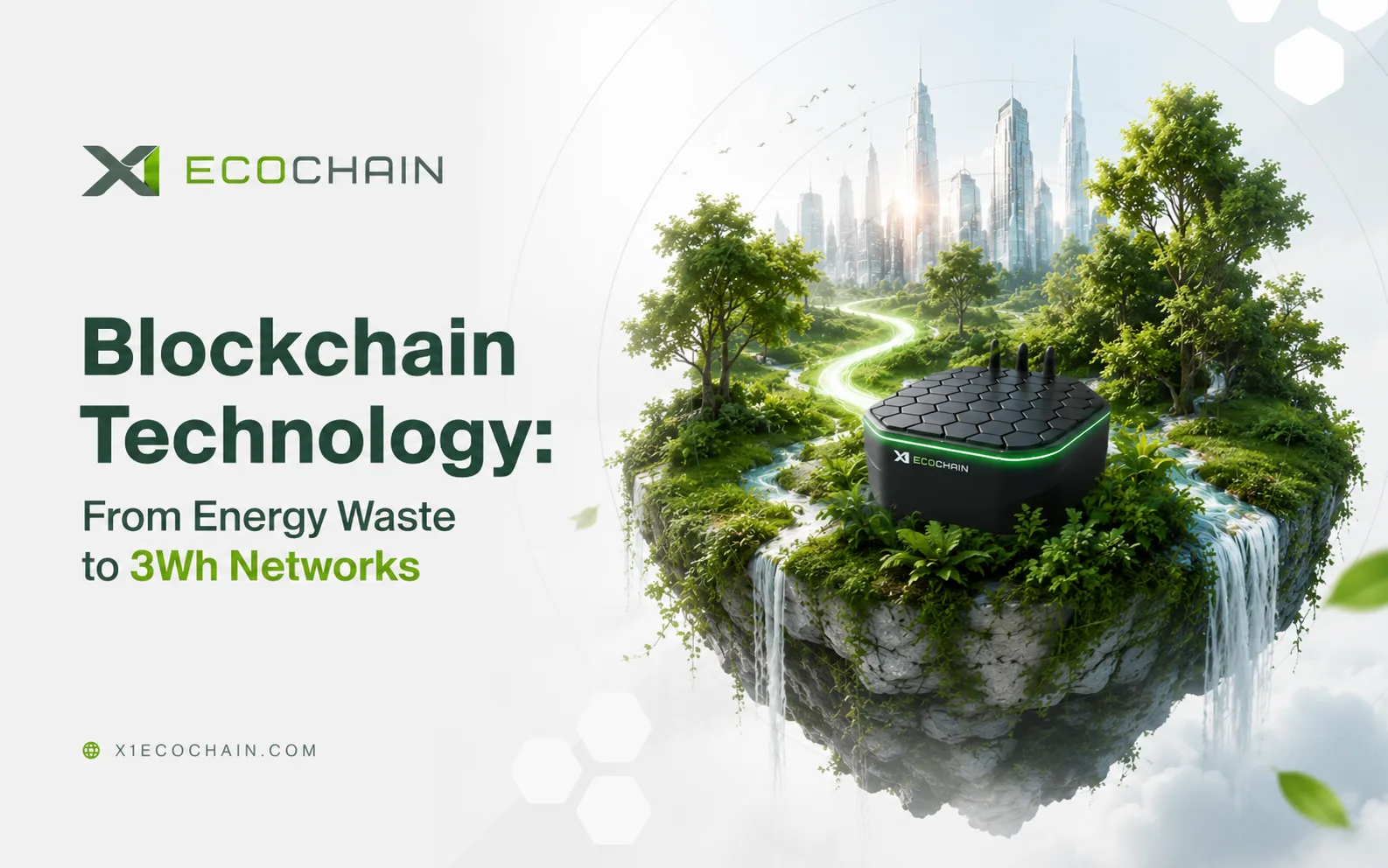
To discover what is blockchain in its truest sense, we must look past complex coding and rethink the physical hardware. A node-based consensus returns to the core philosophy: one person, one vote, one physical device as an indivisible unit of security. A smartphone charger or a Wi-Fi router on standby.
Instead of wasting gigawatts or accumulating massive virtual stakes, this new consensus relies on the physical presence of thousands of compact, low-power home devices.
Flat P2P Architecture
Each home node is an energy-efficient micro-computer forming a flat mesh network:
No Supernodes: There are no privileged servers. Every single node is completely equal.
Sharding & Redundancy: Ledger data is distributed globally across thousands of private households, making the network immune to a single point of failure.
A 3 Wh micro-node produces no heat and operates completely silently (under 5 dB). Protection against a 51% attack is achieved through network topology rather than computing power. It is virtually impossible to shut down a infrastructure consisting of over 7,500 physical devices hidden in bedrooms, offices, and coffee shops across 65+ countries.
The Foundation for Web4: Blockchain and AI Fueling the IoT Era
Why do we look beyond Web3? Because the landscape of the digital economy is changing rapidly. The near future belongs to autonomous software rather than human users.
Within the next few years, millions of AI agents will autonomously hire each other, buy cloud storage, and pay for APIs. Smart homes, autonomous vehicles, and IoT sensors will process billions of microtransactions every second. Legacy systems are completely unsuited for this:
Ethereum fails due to unpredictable gas fees; an AI agent will not pay a $15 fee for a $0.05 transaction.
Solana and similar high-speed chains depend too heavily on centralized cloud data centers.
The Energy Wall: Stacking the massive power requirements of neural network training on top of PoW mining is a direct path to an energy collapse.
The convergence of ai and blockchain requires an entirely different environment. Sub-cent fees (around $0.01 per transaction) make machine-to-machine (M2M) micro-payments viable. The distributed computing power of micro-nodes can also handle lightweight data processing tasks for local artificial intelligence. This intersection of blockchain and ai provides a sovereign, censorship-resistant playground for autonomous applications.
A New Paradigm of Inclusivity
The ultimate victory of a decentralized physical infrastructure network is that it returns a human face to technology. To become a first-tier validator and earn network fees, you no longer need industrial hardware or millions in capital.
You simply place a device the size of a small router on your desk, activate it, and plug it in. The underlying tech stops being an abstract string of code on a rented corporate server. It becomes a tangible physical network owned by the people—creating a green, independent, and truly distributed internet.