
The global digital economy is facing a critical infrastructure crisis. As corporate ecosystems race to deploy complex algorithms, our collective reliance on centralized server farms has exposed massive vulnerabilities in security, data sovereignty, and energy grids. True decentralization cannot exist solely in code; it must be rooted in autonomous physical infrastructure.
To understand why this shift is happening, we must first address a fundamental question that still divides the tech industry: what is blockchain? At its core, the answer defines a tamper-proof, distributed ledger that eliminates intermediaries. However, early architectures compromised either scalability or physical independence to achieve this. The X1 eco chain solves this infrastructure bottleneck by introducing a high-throughput, Layer-1 network powered entirely by decentralized user hardware.
Hardware-Level Sovereignty and the Web4 Transition
Legacy networks often slip into a state of structural illusion, where thousands of virtual nodes end up being hosted on just a handful of cloud providers like AWS or Google Cloud. If a single provider faces an outage or implements strict geopolitical restrictions, the underlying protocols suffer.
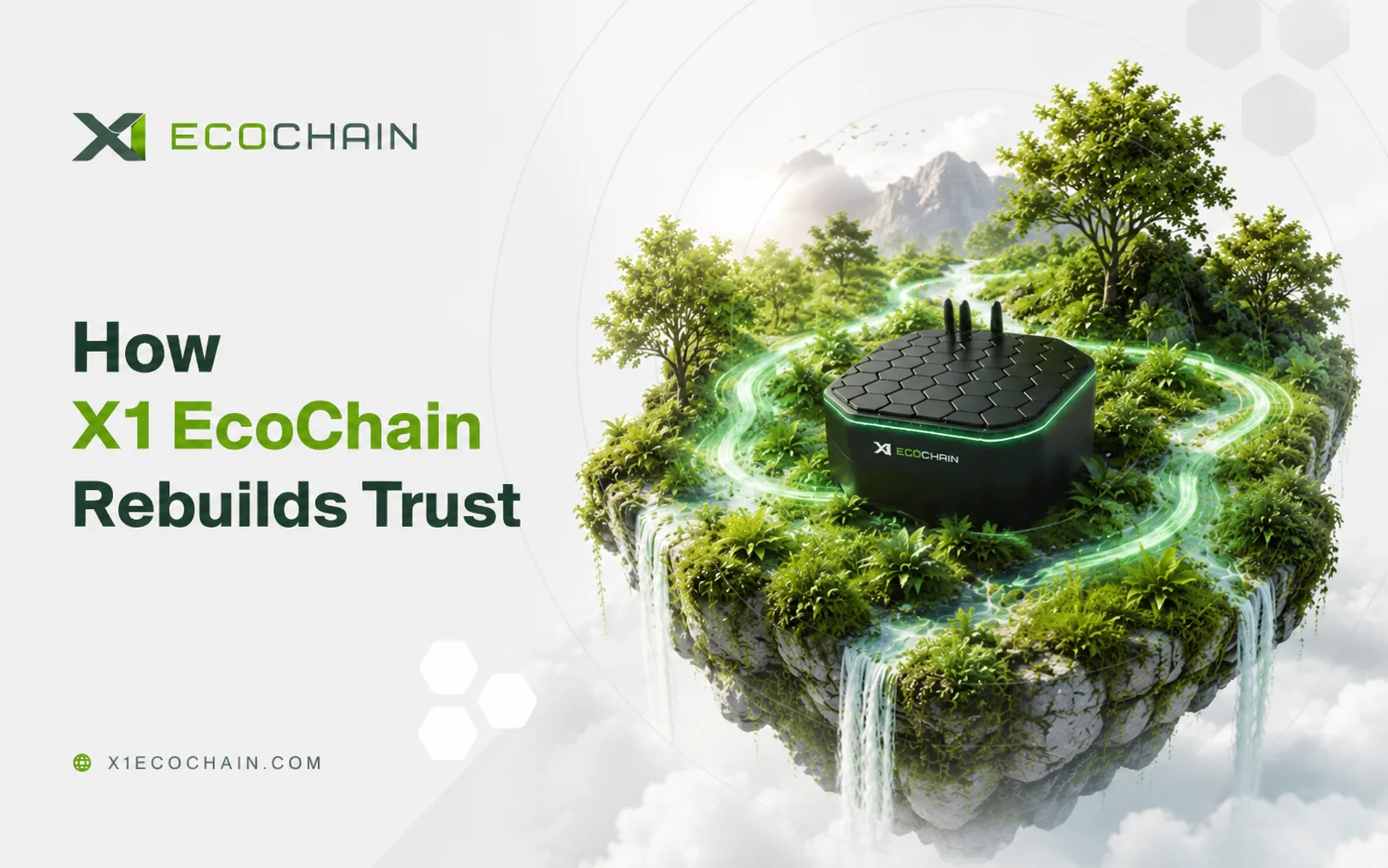
The X1 EcoChain architecture breaks away from corporate data centers through a plug-and-play Decentralized Physical Infrastructure Network (DePIN). The entire ecosystem runs on independent, consumer-friendly hardware units called X1Nodes.
Ultra-Low Consumption: Each physical node operates on just 3 Wh of power—roughly the same energy needed to run a standard home internet router.
Flat P2P Mesh: There are no privileged supernodes or single failure targets. The ledger state is fully replicated and sharded across thousands of equal peers.
Independent Channels: Built-in wireless eSIM capabilities allow the devices to route data and sign blocks via mobile channels if local broadband networks fail.
This physical independence, paired with an immutable ledger, marks a massive shift into the Web4 infrastructure layer—a digital environment where users truly own both the underlying compute power and the physical network nodes.
The Intersection of Smart Networks: AI and Blockchain
As automated systems become the primary drivers of digital commerce, data integrity and cost-efficient processing are non-negotiable. When evaluating modern infrastructure, a strict blockchain comparison reveals that old legacy networks cannot handle high-frequency, sub-cent machine-to-machine interactions.
The convergence of ai and blockchain requires predictable, micro-fee structures. If an autonomous system has to pay $10 in gas fees for a $0.05 data validation task, the deployment model collapses. The X1 network achieves transaction costs under $0.01, allowing software entities to execute microtransactions at scale.
Furthermore, data poisoning remains a major threat to LLMs (Large Language Models). By utilizing the cross-chain capabilities and immutable storage of eco chain, developers can cryptographically verify training logs. Secure data exchange is the missing link in the evolution of ai and blockchain platforms. When autonomous programs can verify where data originates, we prevent black-box decision models from corrupting critical industrial pipelines.
Re-engineering Network Consensus
To fully unpack what is blockchain in the modern era, one must look directly at its consensus mechanism. Instead of relying on hyper-competitive electricity burning or massive concentrations of virtual capital, X1 EcoChain implements Proof-of-Nodes (PoN).
In this system, block integrity and network availability are backed by the real-world, geographical distribution of physical devices. By requiring an active hardware footprint alongside asset staking, PoN naturally dilutes the power of digital oligarchs who dominate typical Proof-of-Stake (PoS) setups.
This specialized design unlocks a robust economic loop where data routing, storage metering, and smart contract execution are handled with minimal overhead. The synchronization between blockchain and ai depends on this exact structural agility.
Building a Scalable Architecture for Autonomous Agents
Looking ahead toward 2030, the digital landscape will be dominated by machine-to-machine economies. Smart cities, autonomous logistics, and decentralized IoT systems require an infrastructure that operates seamlessly in the background without heavy carbon footprints.
A unified approach to blockchain and ai deployment ensures that automated agents can rent decentralized compute units, trade data tokens, and handle cross-chain assets autonomously. When looking closely at what is blockchain outside the scope of simple speculative finance, its ultimate role is to serve as the trust layer for an automated world.
The deep technical alliance between blockchain and ai systems demands networks that are resilient against localized internet outages and corporate cloud monopolies. By anchoring its Proof-of-Nodes consensus into 3-watt household hardware, X1 EcoChain provides the secure, physical foundation that allows the global digital economy to scale responsibly, safely, and without borders.